 OneFix Golf
Join the beta
X-Factor in golf: the stretch between hips and shoulders
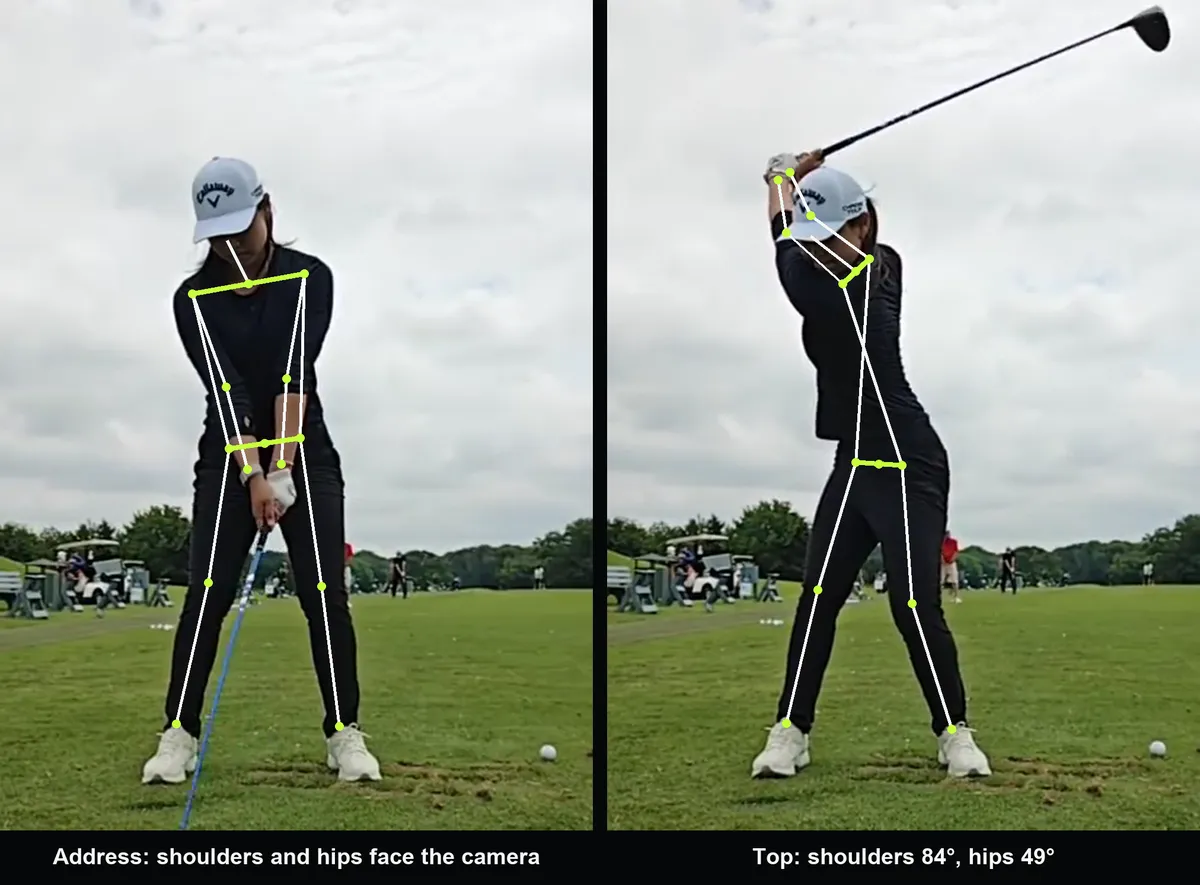
Turn your shoulders 90 degrees and your hips 45 and there is a 45 degree twist in your trunk. That twist has a name, and it is one of the few swing numbers with real research behind it.
The X-Factor is the difference between shoulder turn and hip turn at the top of the backswing. With the shoulders at 90 degrees and the hips at 45 it is 45 degrees. A normal range is 35 to 60 degrees.
- Film it
- Face-on
- Aim for
- Shoulders turned 35 to 60 degrees more than the hips at the top
What it is
The X-Factor is shoulder turn minus hip turn at the top of the backswing. Seen from above, the line across the shoulders and the line across the hips form an X, which is where the name comes from.
A typical value for a good player is somewhere between 35 and 60 degrees.
Why it matters
The muscles of the trunk work like a stretched band. The more the shoulders are wound up against the hips, the more there is to unwind on the way down. A swing where hips and shoulders turn together, as one block, has nothing stored.
More is not automatically better. A big number that you reach by forcing the hips to stay still costs you your balance and your back. Many good players let the hips turn freely and still keep enough of a gap.
Two ways to get it wrong
A small X-Factor with a full shoulder turn means the hips turned too far, often with the trail leg straightening. A small X-Factor with a short shoulder turn means the whole backswing is short. The fix is different, so look at both numbers.
How to measure it
From a face-on video, both turns can be estimated from how much the shoulder line and the hip line narrow between address and the top. OneFix Golf reports shoulder turn, hip turn and the difference. All three are marked as estimates, because they come from a flat picture.
The drill: separation
- Turn your shoulders to the top while the hips stay quieter.
- Hold the top for two seconds and feel the stretch in your trunk.
- Start down with the hips first.
- Three sets of eight swings.
Related guides
- Shoulder turn: how far is enoughFace-on
- Hip sway vs hip turnFace-on
- Swing sequence: what starts downFace-on
More on swing basics
- Swing tempo and the 3 to 1 ratioFace-on or down the line
- Weight shift to the lead sideFace-on
- The 7 positions of the swingFace-on or down the line
- Spine tilt at impactFace-on
Updated 16 November 2026. See how the app measures and the glossary.