 OneFix Golf
Join the beta
Hip sway vs hip turn in the backswing
Ask a golfer who sways to turn their hips and they will tell you they already do. A sideways slide and a turn feel almost the same from the inside. On video they look nothing alike.
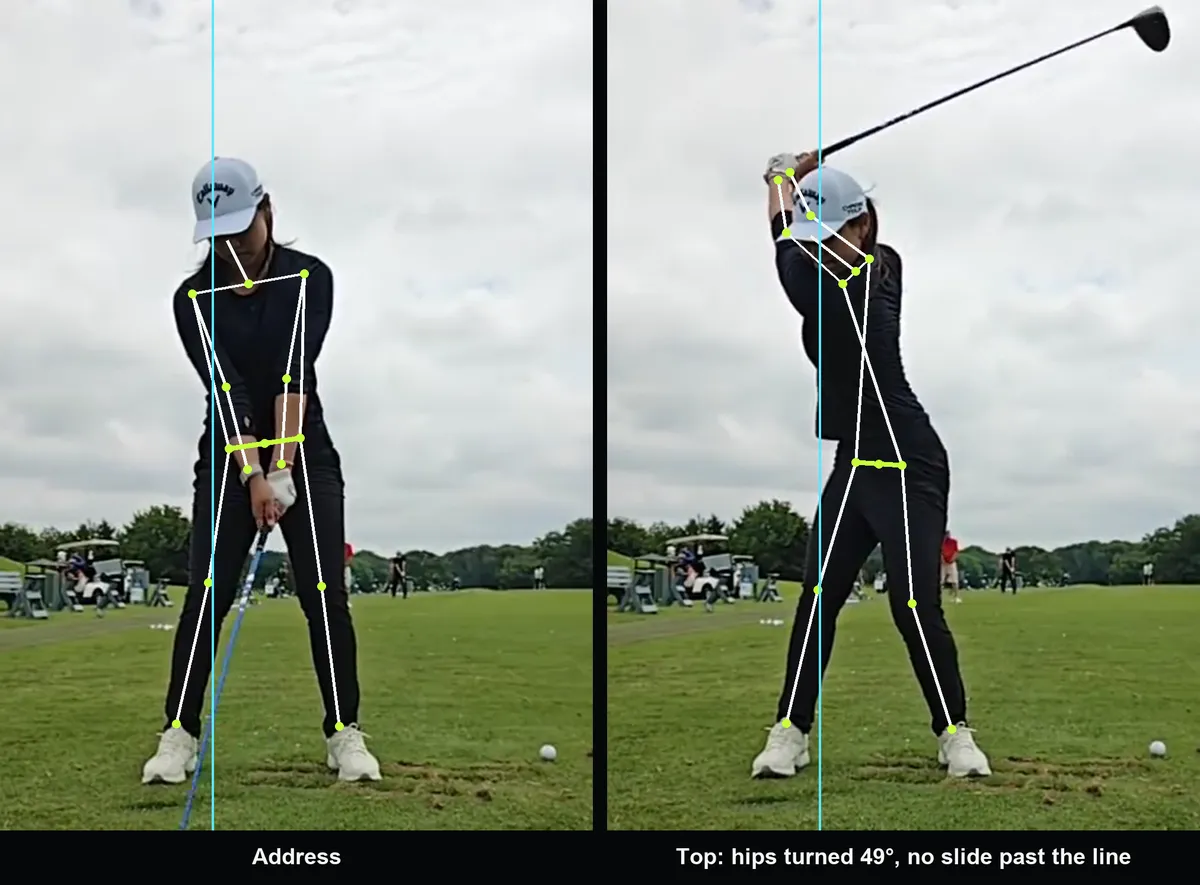
In a hip turn the trail hip moves back behind you while the pelvis stays over the same spot. In a hip sway the whole pelvis slides away from the target. A good backswing turns the hips about 45 degrees and slides them less than 6 centimetres.
- Film it
- Face-on
- Aim for
- Hips move less than 6 cm away from the target in the backswing, and turn about 45 degrees
The difference
In a turn, the trail hip moves back and behind you while the hips stay roughly over the same spot on the ground. In a sway, the whole pelvis slides away from the target and the trail hip ends up outside the trail foot.
A good hip turn at the top is about 45 degrees, half of the shoulder turn. The gap between the two is the stretch that many coaches call the X-Factor.
What sway costs you
If you slide away from the target going back, you have to slide the same distance toward it coming down, and do it at exactly the right time. Some days you manage and some days you do not.
A sway also takes the pressure to the outside of the trail foot, where you cannot push from. A turn keeps it on the inside of that foot.
How to check it on video
Film face-on. At address, draw a vertical line on the outside of your trail hip. At the top of the backswing the hip should not have crossed that line by much.
OneFix Golf measures hip sway in centimetres at the top and reports hip turn in degrees, both from the same face-on clip.
The drill: stick at the trail hip
- Push an alignment stick into the ground just outside your trail hip.
- Swing back without touching it.
- Feel the trail hip turn back behind you and the trail knee keep its flex.
- Three sets of ten swings.
Without a stick, set up with hands on your hips and feel the trail pocket move back instead of sideways.
Related guides
- Weight shift to the lead sideFace-on
- Shoulder turn: how far is enoughFace-on
- Head movement: how much is too muchFace-on
More on swing faults
- Early extension and how to stop itDown the line
- Over the top: where it startsFace-on for the sequence, down the line for the club path
- Bent lead arm at the topFace-on or down the line
- Losing posture at impactDown the line
Updated 16 November 2026. See how the app measures and the glossary.